
Melanotan 1
What is Melanotan 1?


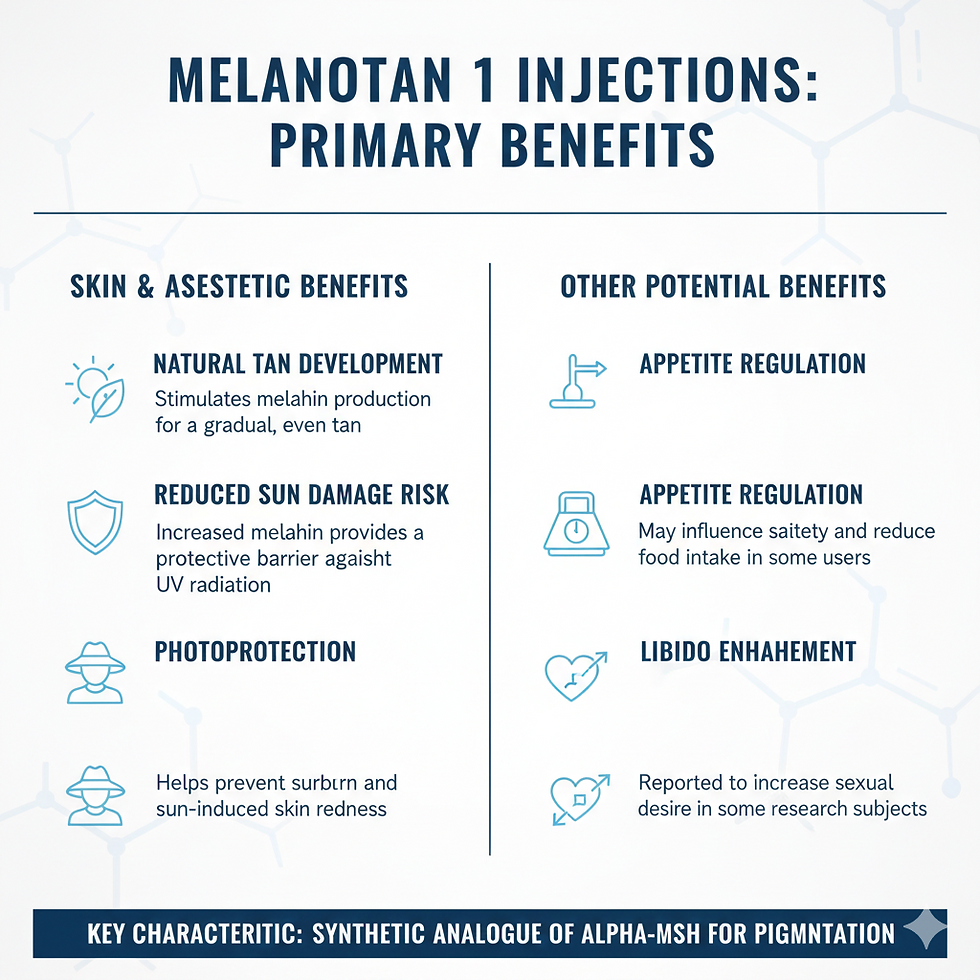
Melanotan 1 (Afamelanotide) is a synthetic analog of the naturally occurring melanocortin peptide alpha-melanocyte stimulating hormone ($\alpha$-MSH). In a research context, it is studied for its ability to induce skin pigmentation (tanning) without the high levels of UV exposure required by traditional tanning.
Unlike Melanotan 2, Melanotan 1 is considered more selective, leading to fewer side effects like appetite suppression or spontaneous arousal, though it typically requires a longer "loading" phase.
________________________________________
1. Reconstitution & Dosage
Melanotan 1 usually comes in 10mg vials as a lyophilized powder.
• Reconstitution: Add 2ml of Bacteriostatic Water to a 10mg vial.
• The Concentration: This creates 5mg (5,000mcg) per 1ml.
• Syringe Measurement: On a standard U-100 (1ml) insulin syringe:
o 10 units (0.10ml) = 500mcg (Common starting dose)
o 20 units (0.20ml) = 1mg (Standard research dose)
Common Research Dosages:
• Initial Dose: 250mcg – 500mcg for the first 2 days to assess tolerance.
• Standard Dose: 1mg per day.
• Maximum Dose: Research protocols rarely exceed 1.5mg – 2mg per day for very large subjects.
________________________________________
2. The Cycle (Loading & Maintenance)
Melanotan 1 works by building melanin levels over time. It does not provide an "overnight" tan.
Phase Duration Frequency
Loading Phase 2–3 Weeks (Until desired shade is met) Once Daily
Maintenance Phase Ongoing (Seasonally) 2–3 Times Per Week
The UV Rule: While Melanotan 1 works by stimulating melanin, it is most effective when paired with minimal UV exposure (10–15 minutes of sunlight 2–3 times a week). This "triggers" the newly produced melanin to darken.
________________________________________
3. Administration & Storage
• Injection Type: Subcutaneous (SubQ) into the abdominal fat.
• Storage: The lyophilized powder is stable at room temperature for short periods, but once reconstituted, it must be kept in the refrigerator.
• Stability: It is best used within 30 days of mixing. Like most peptides, do not shake the vial; swirl gently to dissolve.
________________________________________
4. Potential Side Effects
Melanotan 1 is generally better tolerated than its successor (MT2), but researchers should monitor for:
• Nausea: Most common immediately after injection. Injecting right before bed can help "sleep through" this sensation.
• Facial Flushing: A temporary redness in the face or neck shortly after the dose.
• Darkening of Moles/Freckles: Existing pigment spots may darken significantly before the rest of the skin catches up.
• Lethargy: Some users report a "heavy" feeling or mild tiredness after the first few doses.
________________________________________
5. Summary Checklist for a 10mg Vial
• Reconstitute with: 2ml Bacteriostatic Water.
• Standard Dose (1mg): Pull to the 20 unit mark on a 1ml syringe.
• Vial Longevity: One 10mg vial will last 10 days during the loading phase if injecting 1mg daily.