
Kisspeptin-10
What is Kisspeptin-10?


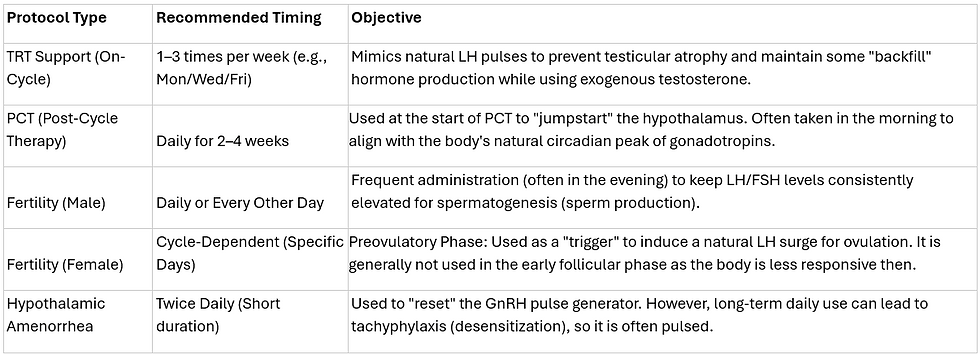
Kisspeptin-10 is often referred to as the "master switch" for the reproductive system. In research, it is used to stimulate the natural release of Gonadotropin-Releasing Hormone (GnRH), which in turn signals the release of Luteinizing Hormone (LH) and Follicle-Stimulating Hormone (FSH).
Unlike HCG, which mimics LH, Kisspeptin-10 works further up the chain to stimulate your body’s natural production. It is primarily studied for libido enhancement, testosterone support, and fertility.
________________________________________
1. Reconstitution & Dosage
Kisspeptin-10 typically comes in 2mg or 5mg vials. It is extremely potent and requires precise dosing.
• Reconstitution: Add 2ml of Bacteriostatic Water to a 5mg vial.
• The Concentration: This creates 2.5mg (2,500mcg) per 1ml.
• Syringe Measurement: On a standard U-100 insulin syringe:
o 4 units (0.04ml) = 100mcg
o 8 units (0.08ml) = 200mcg
o 20 units (0.20ml) = 500mcg
Common Research Dosages:
• Standard Dose: 100mcg to 200mcg.
• Frequency: 1 to 3 times per week.
• Note: Taking it daily is generally avoided in research because it can lead to "desensitization" of the receptors, actually causing the opposite of the intended effect.
________________________________________
2. The Cycle (Duration & Timing)
Kisspeptin-10 has a very short half-life (it works quickly and leaves the body quickly).
Goal Frequency Timing
Libido/Mood Boost As needed (PRN) 30–60 minutes before activity.
Testosterone Support 2–3 times per week Morning or Evening.
PCT/Fertility 3 times per week Monday / Wednesday / Friday.
Cycle Length: 4–8 weeks, followed by a 4-week break to ensure the pituitary gland remains sensitive to the peptide.
________________________________________
3. Administration
• Subcutaneous (SubQ): Inject into the abdominal fat using the rotation map.
• The "Flush": Some users report a very mild, temporary facial flush or a slight increase in heart rate for a few minutes after injection—this is common with Kisspeptin.
________________________________________
4. Storage & Stability
• Extremely Fragile: Kisspeptin-10 is one of the more delicate peptides. Once reconstituted, it must stay in the refrigerator.
• Stability: It is best used within 14–21 days after mixing. Potency drops significantly if it sits for more than a month.
• No Shaking: As with all GH-related peptides, do not shake the vial.
________________________________________
5. Potential Side Effects
• Increased Libido: This is the primary intended "effect," but for some, it can be distracting.
• Mild Nausea: Occasionally reported if the dose is too high (above 500mcg).
• Pituitary Fatigue: If used daily for too long, it can temporarily suppress natural GnRH. Stick to the "pulsed" 2–3 times per week schedule.
________________________________________
The "Vitality Stack"
Researchers often stack Kisspeptin-10 with PT-141:
• Kisspeptin-10: Works on the hormonal/signal side of the brain.
• PT-141: Works on the nervous system/arousal side of the brain.
This Vitality & Hormonal Support Log is designed to help you manage your daily health peptides while layering in the "pulsed" hormonal support of Kisspeptin-10.
Since Kisspeptin is most effective when the body doesn't "expect" it, this log uses a 3-times-per-week cadence (Mon/Wed/Fri) to maximize sensitivity.
________________________________________
Vitality & Hormonal Support Log
Protocol: Daily Repair (Morning) + Pulsed Hormonal Support (As Scheduled)
Day Date Daily Base (e.g., Tesa or BPC) Kisspeptin-10 (200mcg) Notes (Mood/Libido/Energy)
Mon [ ] 8 Units
Tue [ ] — OFF —
Wed [ ] 8 Units
Thu [ ] — OFF —
Fri [ ] 8 Units
Sat [ ] — OFF —
Sun [ ] — OFF —
________________________________________
Vitality Math & Prep
Kisspeptin-10 (5mg Vial)
• Reconstitute with: 2ml Bacteriostatic Water
• Concentration: 2.5mg per 1ml
• The Dose (200mcg): 8 Units on a U-100 Insulin Syringe.
• Vial Longevity: One 5mg vial will provide 25 doses. At 3 doses per week, one vial lasts roughly 8 weeks.
________________________________________
Strategic Timing Tips:
• The Libido Window: If using Kisspeptin specifically for its pro-sexual effects, timing the injection 30–60 minutes before social or intimate activity is the standard research approach.
• The "Empty Stomach" Rule: Like most hormonal signaling peptides, Kisspeptin-10 works best when blood sugar is stable. Avoid injecting immediately after a high-carb meal.
• Syringe Mixing: If you are already taking a daily peptide like BPC-157 or Tesamorelin, you can draw your daily dose and your Kisspeptin into the same syringe on Mon/Wed/Fri to reduce the number of pokes.
________________________________________
Supplies Checklist for an 8-Week Vitality Cycle:
• Kisspeptin-10: 1 x 5mg Vial
• Bacteriostatic Water: 1 x 10ml or 30ml Vial
• Insulin Syringes: 1 box (100 count)
• Alcohol Pads: 1 box (100 count)